
The workload
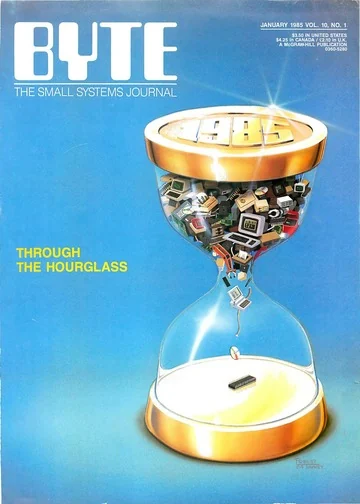
A digitised copy of BYTE, Volume 10, Number 1, January 1985, hosted by the Internet Archive, carries a display advertisement from the Public Domain Software Center of Vista, California, offering to mail out disk libraries from the CP/M Users Group, SIG/M and IBM PC-SIG collections. Verified, because the scanned page is itself the primary artifact: running that mail-order disk business meant maintaining numbered library volumes, duplicating disks to order, and operating both an information phone line and a separate order line, since the ad lists one number for information and a second, described as an anytime order machine, for orders. The same issue's own Unclassified Ads section states BYTE's policy that reader software-exchange listings had to specify the software was written by the individual or is in the public domain, an anti-piracy condition the magazine imposed on its own free classifieds.
What the documents show
Verified, from the ad's own text: January 1985 rates were 45 dollars to rent 46 disks of the CP/M Users Group Library, 45 dollars for the first 46 disks of the SIG/M library, a bundled 85 dollars for the full SIG/M run, and 135 dollars to buy the IBM PC-SIG library outright, plus 5 dollars for a catalog disk and 7.50 dollars per library for shipping and insurance. Rental terms were seven days from receipt with three days' grace to return the disks, paid in advance, no deposit required by credit card. Self-reported, from a separate review in BYTE's June 1985 issue: an unrelated program, PCwindow, was distributed under the user-supported software approach then current, its authors suggesting users who kept it mail 10 dollars, with source code offered for 30 dollars by post; that is a different publisher's own suggested terms, not the January ad's fixed prices.
The operating cost
The January 1985 ad states its own prices in full, as quoted above, for one vendor in one month; it does not represent shareware pricing generally, since public-domain library rental and an individual author's suggested-donation shareware were distinct businesses sharing disk-mail distribution. Neither page states the vendor's or author's own duplication, packaging or postage costs, so a margin cannot be calculated from these pages alone.
The stop condition
The rental ad names a hard stop for each transaction: seven days to use a rented disk set before the three-day grace period ran out, after which, though no penalty is stated, possession fell outside the advertised terms. Editorially, for the mail-order business, the broader stop condition, unstated here, was whatever point postage and order-line costs stopped clearing against 45-to-135-dollar library prices.
- Would a seven-day rental window with a three-day grace period work for a digital product sold today?
- What does keeping two separate phone numbers say about how this vendor managed its own workload?
- Can one dated advertisement ever fairly represent the shareware era, or only the month it ran?
One digitised BYTE issue names real 1985 prices for real disk libraries, in the advertiser's own words, and nothing more; generalizing from one Vista, California vendor's January rate card to the whole decade is exactly the leap this entry avoids making.
Sources & reading trail
Digitised issue containing the Public Domain Software Center display ad with 1985 rental prices and terms, and BYTE's own Unclassified Ads policy.
Source published: 1 January 1985 · Retrieved: 16 September 2026
Digitised issue whose PCwindow review states a separate author's own suggested 10-dollar and 30-dollar source-code fees.
Source published: 1 June 1985 · Retrieved: 16 September 2026
Vendor documentation, regulator records and founder-published documents establish the entry; the workload reading and the stop condition are Solo Product Office editorial analysis. This retrospective draft does not imply the site published on the event date.