
The workload
The Digital Markets Act (DMA) does not ask a solo SaaS founder to do anything directly; it obliges the platforms a founder might build on top of, an app store, a search engine, an operating system, to change how they treat business users. The practical workload for a founder is reading the obligations that attach to a specific gatekeeper's specific service, since the DMA's duties are keyed to individual 'core platform services,' not to gatekeeper companies as a whole.
What the documents show
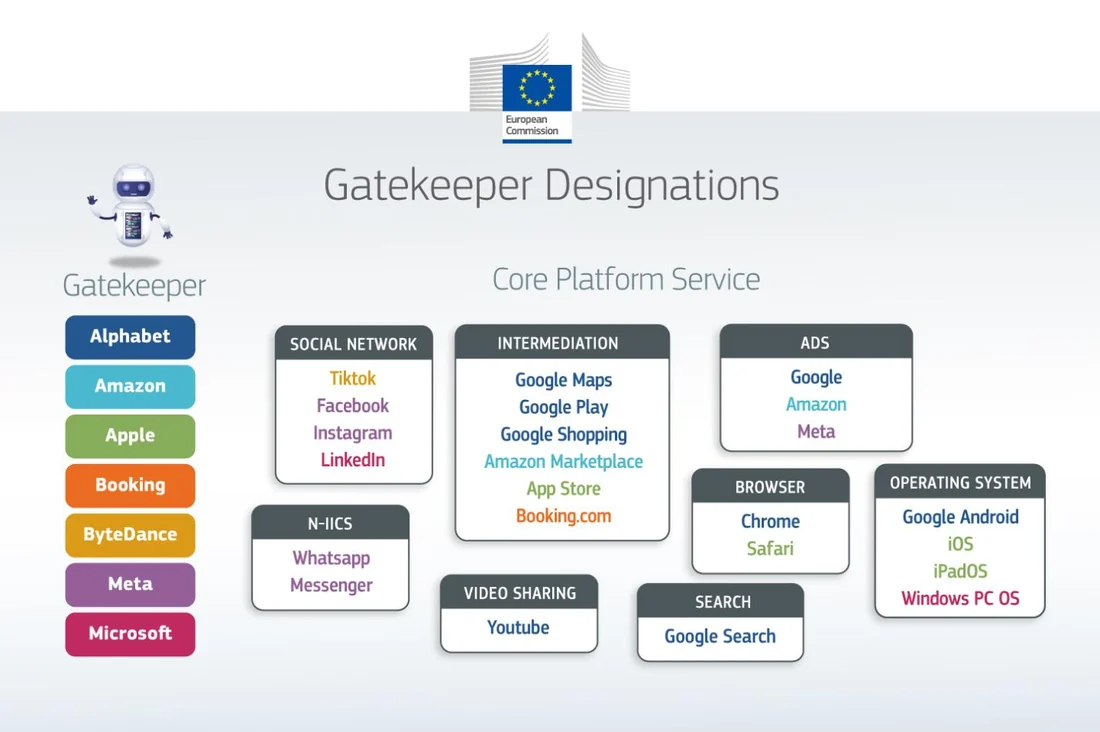
Verified: the European Commission's own gatekeepers page states that on 6 September 2023 it designated the first six gatekeepers, Alphabet, Amazon, Apple, ByteDance, Meta and Microsoft, that Apple's iPadOS and Booking's online intermediation service were added as gatekeeper services in 2024, and that 23 core platform services are currently designated across all gatekeepers combined. Verified: the regulation's own text, Article 3, sets the thresholds a company must meet to be designated, including an annual EU turnover of at least EUR 7.5 billion or a market capitalisation of at least EUR 75 billion, and at least 45 million monthly active EU end users and 10,000 yearly active EU business users for the relevant service. Verified: Article 6(5) prohibits a gatekeeper from ranking its own products or services more favourably than a third party's, and a recital in the same regulation discusses restrictions on installing third-party app stores or applications as the kind of practice the DMA targets. None of these provisions names the founders who build on top of a gatekeeper's platform as the obligated party; the gatekeeper is.
The operating cost
The regulation imposes no fee on a solo founder; any cost runs the other way, in the form of new options a gatekeeper must offer, such as alternative app distribution or non-self-preferencing search rankings, once that gatekeeper implements its own obligations. Neither source prices what a specific founder gains or loses in revenue from a gatekeeper's changed behaviour, since that depends on the specific platform and market.
The stop condition
Editorially, since the DMA describes an ongoing regulatory relationship rather than a one-time filing: the obligations continue as long as a company remains designated, and a founder's practical trigger to recheck anything is a platform's own announcement that it is changing terms to comply with a DMA obligation, such as allowing sideloading or third-party app stores, since those changes come from the platform, not from the founder's own filing.
- Which specific gatekeeper core platform service does the founder's distribution actually depend on, an app store, a search engine, an operating system?
- Has that gatekeeper published DMA-driven changes, such as alternative distribution or ranking rules, that the business could actually use?
- Is a claim that the DMA protects small developers being read from the regulation's actual obligated-party language, or assumed from press coverage?
The DMA is platform regulation, not small-business regulation; its leverage for a solo founder is indirect, running through whatever a gatekeeper is now required to allow, not through any duty imposed on the founder directly.
Sources & reading trail
European Commission's own record of the 6 September 2023 first designations and the later additions, as maintained on the retrieval date.
Source published: Not established · Retrieved: 16 September 2026
The regulation's own designation thresholds at Article 3 and gatekeeper obligations at Article 6, including the self-preferencing prohibition at Article 6(5).
Source published: 12 October 2022 · Retrieved: 16 September 2026
Vendor documentation, regulator records and founder-published documents establish the entry; the workload reading and the stop condition are Solo Product Office editorial analysis. This retrospective draft does not imply the site published on the event date.